
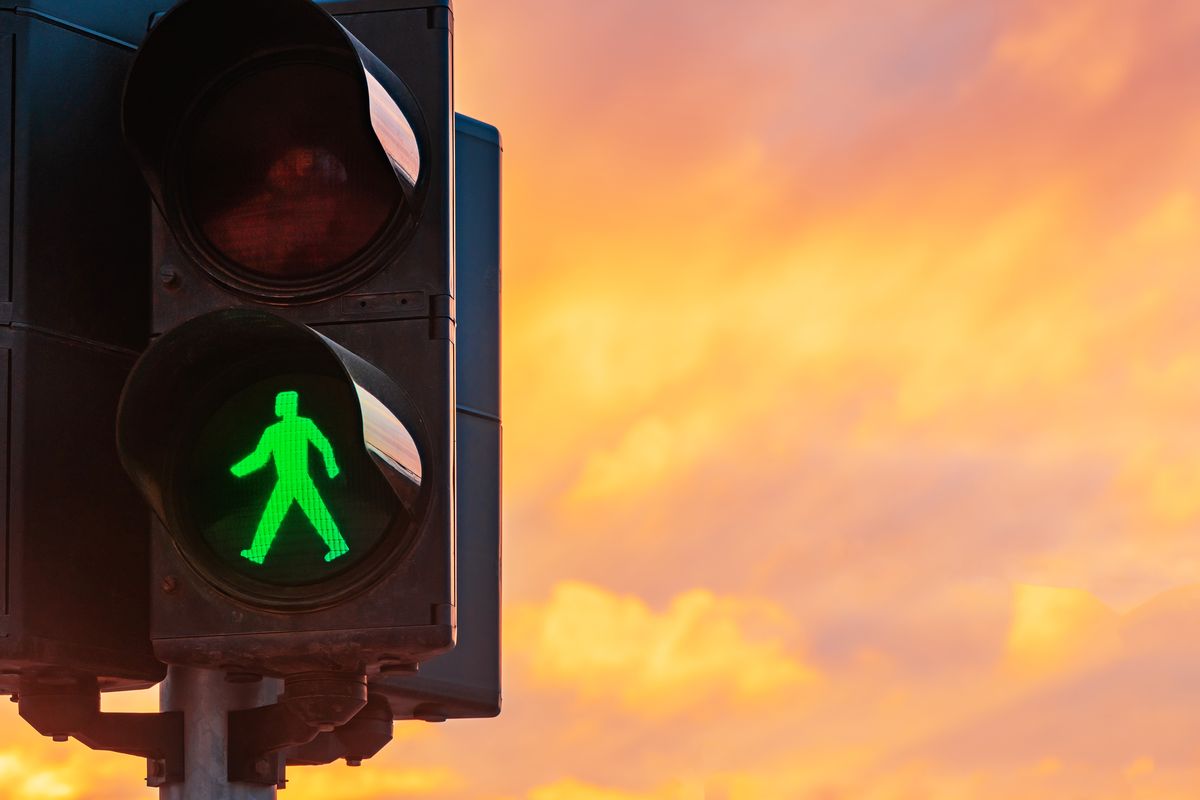
Hit while walking, biking or riding a motorcycle? Which insurer pays and who was at fault are two different questions
I am Mitchell Bisson, a Grand Rapids personal injury lawyer. I have litigated for over 15 years. This page explains how Michigan law treats people who are hurt in a crash without being inside a car: pedestrians, bicycle and e-bike riders, and motorcycle riders. Two things run side by side after one of these crashes. The first is no-fault insurance, which pays medical bills and some lost income no matter who caused the crash. The second is a claim against the driver for pain and suffering, which depends on fault and on how badly you were hurt. I do not promise outcomes.
The short answer. Personal protection insurance (PIP) benefits are due without regard to fault (MCL 500.3105(2)). A person hurt while not an occupant of a motor vehicle claims them under the assigned claims plan unless section 3114(1) points to a policy that covers the injured person, a spouse, or a relative living in the same household (MCL 500.3115; MCL 500.3114(1)). A claim against the driver for pain and suffering needs death, serious impairment of body function or permanent serious disfigurement, and damages are not assessed in your favor if you are more than 50% at fault (MCL 500.3135(1), (2)(b)). The clocks are short: notice to the assigned claims placement facility within 1 year of the accident (MCL 500.3174), and 3 years to sue for most injuries (MCL 600.5805(2)). Nothing here predicts how your case will end.
The first weeks are about medical care and finding every policy that might apply. If insurers dispute which one is responsible, the statute lets the claim go through the assigned claims plan (MCL 500.3172(1)(c), (6)). Fault is the second track. Michigan lets a jury divide fault by percentages instead of barring a claim because you made a mistake (MCL 600.2958; MCL 600.2959).
The rules at a glance
The table sets out the issues I deal with first. Each row is a different question with its own rule.
| Issue | What decides it | Time limit or key rule | Authority |
|---|---|---|---|
| PIP when you were walking or on a bicycle | Whether you, a spouse or a relative living in your household has a Michigan auto policy that applies. If none applies, the assigned claims plan | Notify the Michigan automobile insurance placement facility within 1 year after the accident | MCL 500.3115; MCL 500.3114(1); MCL 500.3174 |
| Suing an insurer for PIP benefits | Written notice of injury to the insurer within 1 year after the accident, or an earlier payment by the insurer | Suit within 1 year after the accident, or within 1 year after the most recent expense or loss if notice was given or benefits were paid. Tolled from a specific claim until a formal denial | MCL 500.3145(1)-(3) |
| PIP on a motorcycle in a crash with a motor vehicle | A set order of insurers, starting with the insurer of the owner or registrant of the motor vehicle involved | Subsections (6) and (7) adjust the order for policies without PIP coverage and for shared priority | MCL 500.3114(5)-(7) |
| A motorcycle crash with no motor vehicle involved | A motorcycle accident with no motor vehicle involved falls outside standard PIP. Optional first-party medical benefits apply only if bought | Insurers must offer motorcycle owners first-party medical benefits in $5,000 increments | MCL 500.3101(3)(h), (j); MCL 500.3103(2) |
| Pain and suffering claim against the driver | Death, serious impairment of body function or permanent serious disfigurement | Impairment must be objectively manifested, involve an important body function and affect your general ability to lead your normal life | MCL 500.3135(1), (5) |
| Your own share of fault | The jury finds each person’s percentage and damages are reduced by yours | If your fault is greater than the others’ combined, noneconomic damages are not awarded. In a motor vehicle claim for noneconomic loss, damages are not assessed for a party more than 50% at fault | MCL 600.2959; MCL 600.6304(1)-(2); MCL 500.3135(2)(b) |
What a driver owes you and what the law asks of you
A claim against a driver is a negligence claim: duty, breach, causation and damages (Case v Consumers Power Co, 463 Mich 1, 6 (2000)), and the general period of limitations for an injury to a person is 3 years (MCL 600.5805(2)). Causation has two parts. The driver’s conduct must be a cause in fact, meaning the injury would not have happened without it, and a legal or proximate cause (Craig v Oakwood Hosp, 471 Mich 67, 86-87 (2004)).
Michigan courts have long described what each side owes. A pedestrian, before crossing, must observe approaching traffic, judge its distance and speed, keep observing while crossing, and use the care an ordinarily careful and prudent person would use (Malone v Vining, 313 Mich 315, 321 (1946)). Drivers must notice persons in the street and use reasonable and ordinary care not to run them down (Birkhill v Todd, 20 Mich App 356, 359-360 (1969)). Both decisions come from the era when a plaintiff’s own negligence could bar a claim entirely. Today a pedestrian’s mistakes reduce the damages instead of ending the claim (MCL 600.2958; MCL 600.2959).
The Vehicle Code supplies much of the proof. A driver must drive at a careful and prudent speed that is reasonable and proper for the traffic, surface, width and conditions, and must not drive faster than allows a stop within the assured, clear distance ahead (MCL 257.627(1)). At a green light, vehicles, including those turning left or right, must yield to pedestrians and bicyclists lawfully within the intersection or an adjacent crosswalk (MCL 257.612(1)(a)). When a pedestrian signal shows a walk interval, the pedestrian may proceed and is to be given the right of way by the drivers of all vehicles (MCL 257.613(2)(a)). A driver passing a bicycle going the same direction must pass at a safe distance of at least 3 feet to the left, or, if that is impracticable, at a safe distance and a safe speed (MCL 257.636(2)).
The statute also asks things of you. Where sidewalks are provided, a pedestrian shall not walk on the main traveled portion of the highway (MCL 257.655(1)), and a pedestrian facing a steady red signal shall not enter the highway unless they can do so safely and without interfering with vehicular traffic (MCL 257.613(1)(c)).
Breaking a traffic statute is not automatic liability in Michigan. When a court adopts a penal statute as the standard of care, a violation establishes a prima facie case of negligence, and the finder of fact decides whether the party accused of violating it had a legally sufficient excuse (Zeni v Anderson, 397 Mich 117, 143 (1976)). The Supreme Court has also described the rule as a rebuttable presumption of negligence (Klanseck v Anderson Sales & Service, Inc, 426 Mich 78, 86 (1986)). The same rule applies to a violation by the injured person.
Hit while crossing: crosswalks, signals and the pedestrian’s share of fault
People assume that a pedestrian outside a painted crosswalk has no claim. The statute does not say that. A crosswalk includes the part of a roadway at an intersection within the connections of the lateral lines of the sidewalks on opposite sides, and any portion of a highway at an intersection or elsewhere distinctly indicated for pedestrian crossing by lines or other markings (MCL 257.10). A pedestrian facing a green signal may cross within a marked or unmarked crosswalk (MCL 257.613(1)(a)). Whether you were in one is a question of fact that I answer with the scene and the signal timing.
If you were crossing between intersections or against a signal, the claim is not over. The jury assigns you a percentage of fault by considering the nature of your conduct and how closely it was connected to the damages claimed (MCL 600.6304(1)-(2)), and it weighs the driver’s conduct in the same exercise. Fault can also be assigned to a person who is not a party to the lawsuit (MCL 600.2957(1)). A simple example shows the arithmetic. If a jury finds total damages of $200,000 and assigns you 30% of the fault, the court reduces the damages by 30% (MCL 600.2959). If it assigns you 60%, your fault is greater than the combined fault of the others, so economic damages are reduced by 60% and noneconomic damages are not awarded.
No-fault benefits when you were not in a car
PIP benefits are paid by an insurer, not by the driver, and they are due without regard to fault (MCL 500.3105(1)-(2)). They cover allowable expenses, meaning reasonable charges for reasonably necessary products, services and accommodations for your care, recovery or rehabilitation; work loss for income you would have earned during the first 3 years after the accident; and replacement services of up to $20 per day for the first 3 years (MCL 500.3107(1)(a)-(c)).
The harder question is which insurer is responsible. For a pedestrian or a bicyclist, section 3115 sends the claim to the assigned claims plan, except as section 3114(1) provides (MCL 500.3115). Section 3114(1) applies the PIP policy of the person named in the policy, the person’s spouse, and a relative of either domiciled in the same household, if the injury arises from a motor vehicle accident (MCL 500.3114(1)). So a household policy matters even though you were on foot. If benefits are payable under your own policy and also under a spouse’s or relative’s policy, your own insurer pays all of the benefits up to the coverage level and cannot seek recoupment from the other insurer.
The assigned claims plan is the fallback. A person may claim through it when no PIP insurance applies, none can be identified, insurers dispute their obligations, or the only identifiable insurer cannot pay because of financial inability (MCL 500.3172(1)). A hit-and-run where the driver is never found can fit that wording, because subsection (1)(b) turns on whether applicable PIP insurance can be identified, not on whether the other driver can be identified. A household policy that applies first under MCL 500.3114 still comes before the plan. That is a reading of the statutory text, and I am not relying on a reported Michigan decision for it. A claimant files a completed application with the placement facility and provides reasonable proof of loss (MCL 500.3172(3)), and must notify the facility within 1 year after the accident (MCL 500.3174). I treat that 1-year notice as the first deadline in the file.
The lawsuit deadline is separate. An action for PIP benefits may not be commenced later than 1 year after the accident unless written notice of injury was given to the insurer within that year or the insurer already paid benefits (MCL 500.3145(1)). Once notice is given or a payment is made, suit may be filed within 1 year after the most recent allowable expense, work loss or survivor’s loss was incurred, but no benefits are recoverable for loss incurred more than 1 year before suit (MCL 500.3145(2)). The period is tolled from a specific claim until the insurer formally denies it, if the claimant pursues the claim with reasonable diligence (MCL 500.3145(3)).
Bicycles and e-bikes
A person riding a bicycle on a roadway has all of the rights, and is subject to all of the duties, of the driver of a vehicle under the Vehicle Code, except for special regulations and provisions that by their nature do not apply (MCL 257.657).
One duty matters in every crash after dark. A bicycle operated on a roadway between one half hour after sunset and one half hour before sunrise must have a lamp on the front that emits a white light visible from at least 500 feet to the front and a red reflector on the rear (MCL 257.662(1)). If you were riding after dark, I look at your lighting early, because the other side will.
For no-fault purposes, the definition of a motor vehicle excludes motorcycles, mopeds and electric bicycles, among other things (MCL 500.3101(3)(i)). An electric bicycle has a seat or saddle, fully operable pedals and an electric motor of not more than 750 watts, and falls within one of three classes (MCL 257.13e). None of this takes away your PIP rights when a car hits you. A crash that involves a car as a motor vehicle is a motor vehicle accident whether or not a bicycle is involved (MCL 500.3101(3)(j)), and you claim as a person who was not an occupant of that car.
Motorcycle riders
For no-fault purposes a motorcycle has a saddle or seat, is designed to travel on not more than 3 wheels in contact with the ground and has a motor that exceeds 50 cubic centimeters piston displacement (MCL 500.3101(3)(g)). Which insurer pays you depends on whether a motor vehicle was involved. If one was, section 3114(5) sets the order: the insurer of the owner or registrant of that vehicle, the insurer of its operator, then the motor vehicle insurer of the motorcycle operator, then the motor vehicle insurer of the motorcycle owner or registrant (MCL 500.3114(5)).
If no motor vehicle was involved, the standard PIP system does not apply. Insurers that cover a motorcycle must offer first-party medical benefits only, in increments of $5,000 (MCL 500.3103(2)), so whether you bought that coverage is the first fact I check.
Michigan requires a crash helmet for a person operating or riding on a motorcycle, except under subsection (5) (MCL 257.658(4)). A person 21 or older who has held a motorcycle endorsement for at least 2 years, or who passed an approved motorcycle safety course, may ride without one, as may a passenger, but only if the operator or rider has first-party medical security of at least $20,000 (MCL 257.658(5)). Helmet nonuse is an argument the defense raises, and the law on it is thin. The helmet statute does not say that nonuse is evidence of negligence or that any reduction is capped. The seat belt statute has a 5% cap, but it does not apply to a motorcycle occupant (MCL 257.710e(1)(c), (8)). I did not find a published Michigan decision applying the comparative fault statutes to helmet nonuse. The question turns on the general rules: fault includes conduct that is a proximate cause of damage (MCL 600.6304(8)), and a helmet does not cause a crash, so the defense argues that nonuse made the injuries worse.
Left turns have their own rule. A driver within an intersection intending to turn left must yield to a vehicle approaching from the opposite direction that is within the intersection or so close as to constitute an immediate hazard (MCL 257.650(1)). A motorcycle is a vehicle under the Vehicle Code (MCL 257.79), and a bicycle rider on the roadway has a driver’s rights (MCL 257.657). I am not relying on a reported Michigan decision applying section 650(1) to a collision with a motorcycle or bicycle rider, so the analysis rests on the statutes and the general negligence cases.
Injury threshold, deadlines and the evidence that decides a claim
Even when the driver is plainly at fault, a claim for pain and suffering has to clear the threshold. Whether the injured person has suffered a serious impairment of body function or permanent serious disfigurement is a question of law for the court if there is no factual dispute about the nature and extent of the injuries, or if the dispute is not material to that question. For a closed-head injury, a question of fact for the jury is created if a licensed allopathic or osteopathic physician who regularly diagnoses or treats closed-head injuries testifies under oath that there may be a serious neurological injury (MCL 500.3135(2)(a)).
The proof disappears quickly. I look for the crash report, 911 audio, video from nearby businesses and doorbells, signal timing, scene photographs, the helmet and clothing, the bicycle or motorcycle in its unrepaired condition, phone records and witness names. Please do not throw out or repair a damaged bicycle or helmet before I have documented it.
How I handle a pedestrian, cyclist or motorcycle crash case
- Protect the benefits first. I check the household policies, the vehicle involved and the assigned claims plan, and I calendar the 1-year notice and suit deadlines on the day you call.
- Secure the evidence. I send preservation requests for video, data and vehicles, and I photograph and keep the bike, helmet, clothing and gear.
- Build the fault picture. I work out where you were, the signal phase, speed, lighting and sight lines, and which statutes applied to the driver and to you.
- Document the injury. I collect the medical and work records that show how the injury changed your life, because the pain and suffering threshold turns on them.
- Deal with the insurers. I give notice, answer reasonable requests, push back on the rest and tell you what to say and not say to an adjuster.
- Evaluate, then negotiate or file. I put the fault percentages, the threshold and the damages side by side and tell you where the weak points are. If a claim does not settle on terms worth accepting, I file within the limitations period and prepare it for trial.
Ways a crash claim may end without a trial
Most claims like these are resolved by negotiation with the insurers after the medical picture is clear. Others end by dismissal if the injury does not meet the threshold, or by a verdict after a trial. I do not promise outcomes. PIP benefits are a separate claim and are due without regard to fault, so they do not depend on how the claim against the driver ends (MCL 500.3105(2)).
What I need from you
Bring the police report or its number, your medical bills and records, photographs of the scene and your injuries, and the names of witnesses. Bring your own auto insurance policy and any policy held by a spouse or relative who lives with you, plus everything the insurer has sent you. Keep the bicycle, motorcycle, helmet and clothing as they are. Write down what happened while it is fresh. Do not give a recorded statement to the other driver’s insurer until you and I have talked, and do not post about the crash online.
Where your Kent County crash case will be heard
I represent clients in Grand Rapids, Kentwood, Grandville, Wyoming and across Kent County. Under MCL 600.8301(1), the district court has exclusive jurisdiction in civil actions when the amount in controversy does not exceed $25,000.00. Michigan law sets the Kent County district courts by municipality. The 61st District Court serves the city of Grand Rapids, the 59th serves the cities of Grandville and Walker, the 62A serves the city of Wyoming and the 62B serves the city of Kentwood. MCL 600.8128a; MCL 600.8130(1)-(3). The 63rd District Court serves the rest of Kent County, which includes the cities of Rockford, Lowell, Cedar Springs and East Grand Rapids and the surrounding townships. MCL 600.8130(4). Larger claims are filed in the Kent County Circuit Court, which is the 17th Judicial Circuit. MCL 600.518.
Why people hire me for a Michigan pedestrian, cyclist or motorcycle crash
You work directly with me, the lawyer handling your case. I tell you where the proof is strong and where it is thin, what the fault arguments are likely to be, and what the no-fault rules do and do not cover. I do not promise outcomes. I build the case the facts support and prepare it for trial, because an insurer deals differently with a claim that is ready to be tried.
My fee depends on the type of case, how complicated it is and how far it is likely to go. I explain the fee at the consultation, before you decide whether to hire me.
Questions I hear from people hurt on foot, on a bicycle or on a motorcycle in Michigan
I was hit by a car while walking. Can I get no-fault benefits?
Yes, in most cases. MCL 500.3115 says a person injured while not an occupant of a motor vehicle claims PIP under the assigned claims plan, except as provided in section 3114(1). So if you, your spouse, or a relative domiciled in your household has a Michigan auto policy, that policy applies first. If not, you go through the assigned claims plan, which requires notice of the claim to the placement facility within one year after the crash.
A driver hit me while I was crossing the street in Michigan and I was not in a marked crosswalk. Can I still recover?
Often yes. Crossing outside a marked crosswalk does not bar a claim in Michigan. A driver must still use reasonable care not to run down a pedestrian, and a pedestrian must use reasonable care too, so the jury assigns a percentage of fault to each. The pedestrian's percentage reduces the damages, and if it is greater than the combined fault of the others, noneconomic damages are not awarded. Many intersection crossings count as crosswalks under the Vehicle Code even without paint. No-fault benefits are due without regard to fault.
I was riding a bicycle when a driver hit me. Can I sue the driver for pain and suffering?
Possibly. A claim for noneconomic loss against a driver is allowed only if you suffered death, serious impairment of body function, or permanent serious disfigurement under MCL 500.3135(1). If you are more than 50% at fault (MCL 500.3135(2)(b)), or your fault is greater than the combined fault of the others (MCL 600.2959), noneconomic damages are not awarded. Your PIP benefits come first through the rules for non-occupants in MCL 500.3115 and 3114(1).
I was hurt on my motorcycle in a crash with a car. Whose insurance pays PIP benefits?
When a motor vehicle is involved, MCL 500.3114(5) sets this order for a motorcycle operator or passenger: first the insurer of the owner or registrant of the motor vehicle involved, then the insurer of that vehicle's operator, then the motor vehicle insurer of the motorcycle's operator, then the motor vehicle insurer of the motorcycle's owner or registrant.
What coverage applies if I crash my motorcycle and no car is involved?
A crash that involves a motorcycle but no motor vehicle is a motorcycle accident under MCL 500.3101, not a motor vehicle accident. Standard PIP benefits do not apply to a motorcycle-only crash. Insurers must offer motorcycle owners optional first-party medical benefits in $5,000 increments under MCL 500.3103(2), so whether you bought that coverage becomes important.
Does not wearing a helmet hurt my injury claim after a motorcycle or bicycle crash in Michigan?
It can be raised by the defense, but Michigan has no helmet provision like the seat belt rule, which caps the reduction at 5%. No published Michigan decision on helmet nonuse and damages was located for this answer, so the issue turns on the general comparative fault statutes and on whether nonuse was a cause of the injuries claimed. The helmet statute covers motorcycle riders, with exceptions for some adults, and some young moped and electric skateboard riders. Its text lists no helmet requirement for bicycle riders.
A car turned left in front of me while I was on a motorcycle or bicycle in Michigan. How is fault decided?
At an intersection, the driver turning left must yield to an oncoming vehicle that is within the intersection or so close that it is an immediate hazard, and a bicycle or moped rider on the roadway has the rights and duties of a vehicle driver. A left turn into an oncoming rider is therefore often strong evidence against the turning driver. The rider's speed, lane position and attention can still be weighed, and the jury assigns percentages. A rider found more than 50% at fault cannot recover noneconomic damages.
Related Michigan pages
- Grand Rapids personal injury lawyer
- Car accident
- Truck accident
- Who pays no-fault benefits and assigned claims
- Uninsured and underinsured motorist claims
- Negligence
- Michigan legal FAQs
I represent people hurt as pedestrians, cyclists and motorcycle riders in Kent County and West Michigan. Contact me 24/7 by phone or email. Your Rights, My Fight! Call for a free initial consultation.
Big-Firm Power. Street-Level Grit.
Law Offices of Mitchell S. Bisson, 2828 Kraft Ave SE, Suite 295, Grand Rapids, MI 49512, serving Kent County and West Michigan.
This page provides general information about Michigan law and is not legal advice. Reading it does not create an attorney-client relationship. Laws change and every case turns on its own facts. Consult a licensed attorney about your specific situation.